Every pastor I know has said some version of "we need to shut the back door." Almost nobody has a plan for it. Noah Herrin does, and it comes down to two words.

I sat down with Pastor Noah Herrin of Way Church in Nashville for his third time on the podcast, and he gave the clearest answer I have heard on this. Way Church is about to pass 1,700 salvations in under three years and is launching a second location this fall, so he has had to solve this in real time, not in theory. Here is what he said, plus the practical pieces underneath it.
Noah's answer was fast, and it was not a program.
"It's either community or it's mission that's going to shut the back door. So as quickly as you can get someone into community or a part of your mission, the less likely they are to leave."
That is the whole thing. A person who has made a friend at your church has a reason to come back that has nothing to do with whether your sermon landed that week. A person who is serving on a team has a role, a text thread, and people who notice when they are not there. Everything else you do is scaffolding around those two.
Which means your connection strategy is not "how do we get people to like us more." It is "how fast can we get a new person into a group or onto a team." If your current process does not answer that question with a number of weeks, you do not have a process yet.
The most common mistake Noah sees is churches running one blanket strategy and hoping it works on everybody.
Think about who walked into your building last Sunday. A thirty year old single mom. A twenty year old college student who loves your church. A fifty year old couple who just became empty nesters. They are looking for completely different things, they have completely different amounts of margin, and they need to hear from you in completely different ways. If you run one message to all of them, you will consistently miss somebody, and you will never quite know who.
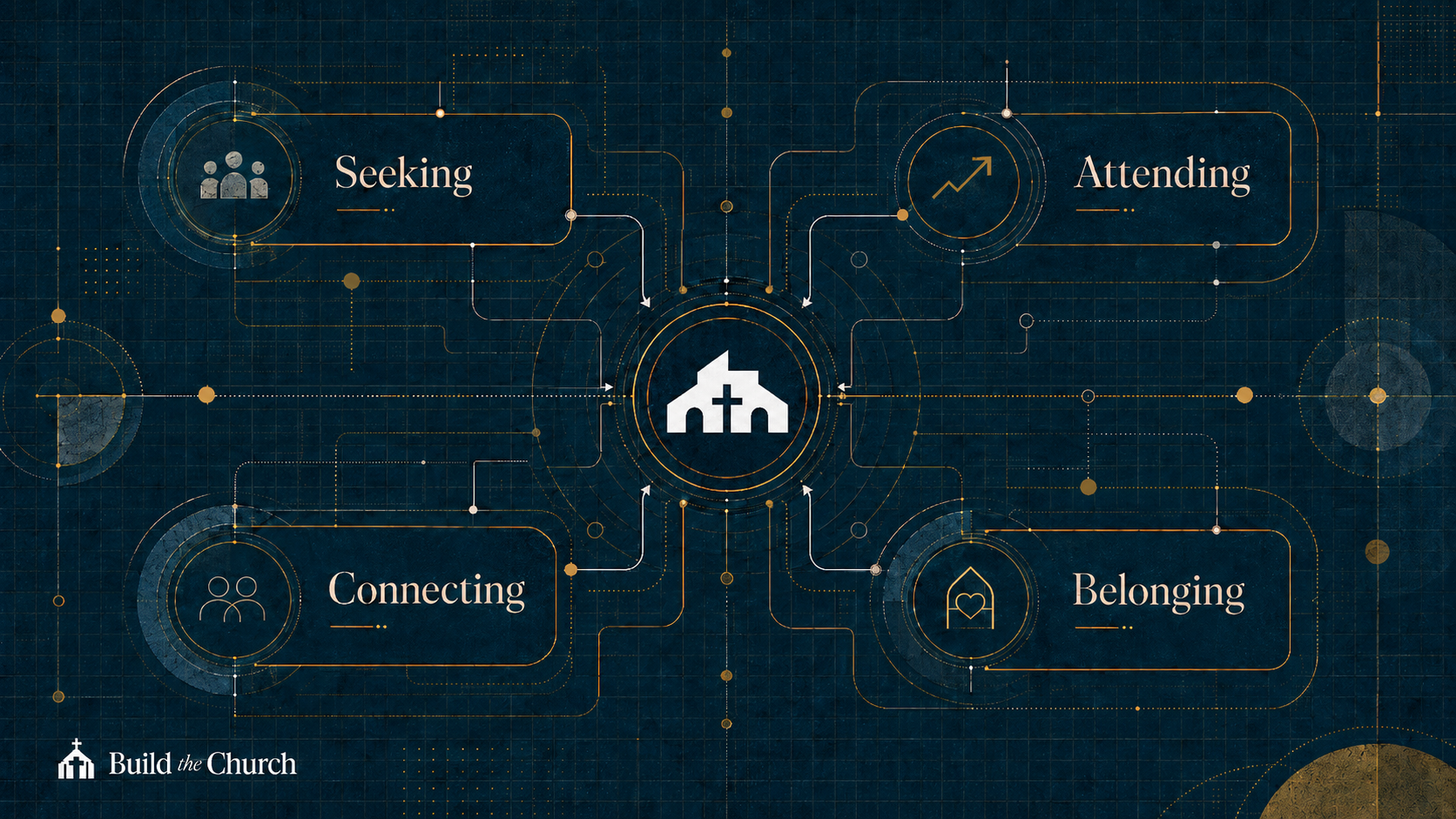
At Way Church, that led to sorting every person into one of four stages, then communicating to each stage differently:
The tone shift matters as much as the content. A first-time guest gets a warm video from Noah and his wife Maddie saying they are honored you tried us out. Somebody in the belonging stage gets something that reads like a family group text. Same church, completely different voice, because they are in completely different places.
You do not need software to start this. You need to know which stage each person is in, and you need to stop sending one email to all of them.
Here is the part I would steal immediately. Way Church defines "belonging" with three specific behaviors. A person belongs if they are doing at least one of these:
Notice the logic. If they serve, they are on a team, so they belong. If they are in a group, they are in deep relationship, so they belong. And if they give, well, where your treasure is, your heart will be also. Their heart is clearly here.
Most churches talk about connection in feelings. Way Church turned it into a number they can look at on a Tuesday. That is the difference between hoping people are connected and knowing.
Noah also said they tweak the definition as the church changes seasons, which I appreciate. Pick a definition you can defend today, measure against it, and adjust when it stops describing reality.
Imagine walking into a car dealership. You find the exact car you want, you have your financing ready, and the salesman says, "We only sell those on the third Friday of every month. That Friday just happened. Come back in six weeks and it is yours."
That dealership closes. And yet that is exactly how a lot of churches run their growth track.
Noah is a hard believer in a weekly next step. Way Track happens every single Sunday. If you only offer yours once a month or once a quarter, do the math on what that costs: a person shows up ready, motivated, and open, and you ask them to hold that feeling for five weeks. Most people cannot. Momentum has a shelf life.
"If you're only doing that once a month or if you're only doing that once a quarter, you are severely hurting yourself when it comes to shutting the back door."
If weekly feels impossible with your staffing, start by cutting the gap in half. Monthly to every other week is a real win.
Offering it weekly creates a new problem: how do you talk about the same thing fifty-two times without everyone tuning it out?
Way Church's answer is to fight for a new way to promote it every week, and the thing that moves people is almost never information. It is a story. Bring up a couple who was not sure about going. They went. They met their best friends. Now they are plugged in and leading a small group. Nobody is moved by "please sign up for Way Track." Everybody is moved by watching somebody like them take the risk and come out the other side with friends.
Three ingredients, every week: a clear invitation from the stage, a clear explanation of how, and a real story of somebody it worked for.
Here is the stat from the episode that I cannot get out of my head. An ARC church in Virginia with multiple locations was running a growth track and converting about forty percent of attenders into a group or a serving team. Then they built out real automated follow-up for the people who came but did not sign up on the spot.
Their conversion went from forty percent to over sixty-five percent.
They did not change the class. They did not change the preaching. They changed what happened in the seven days after. Those are people who were already interested enough to show up, and they were falling through the cracks purely because nobody circled back.
Ask yourself honestly: what happens at your church to a person who attends your next steps class and does not sign up for anything? If the answer is nothing, that is not a small leak. That is the biggest one you have, and it is the cheapest to fix.
Noah's executive pastor, Connor Crumpton, came out of the business world and got frustrated that they were paying for ads in one place, their database in another, and texting in a third, with none of it talking to each other. He spent about ten hours a week for a year building something that solved it, and that became Church Grids, now used by more than thirty churches from a couple hundred people to a few thousand.
Most pastors do not have a Connor on staff. That is exactly why they opened it up. But whether you use their tool or not, the principle holds: if you are serious about getting better at connection, it is going to take some time and some money, the same way getting healthier does. Nobody gets in shape by intending to.
If you only do one thing, do this: pick your definition of belonging, count how many of your people meet it, and look at the gap. That number will tell you more about your church than your attendance number will.
Then work backward. Make the next step weekly. Follow up with everybody who came and did not sign up. Talk to a first-time guest differently than you talk to a volunteer of three years. Get people into community or onto the mission as fast as you possibly can.
There is a lot more in the full conversation, including why Noah started tackling hot cultural topics head-on and what Josh Howerton told him that finally convinced him to do it. Watch it below.




















.png)